Choosing a Medicare Advantage plan in Los Angeles, California can feel overwhelming. Between provider networks, hospital systems, referrals, and plan costs, many seniors are unsure whether an HMO or PPO plan makes more sense.
Whether you live in Westwood, Beverly Hills, Santa Monica, Brentwood, West Hollywood, Downtown Los Angeles, Hollywood, Koreatown, Silver Lake, Sherman Oaks, Encino, Woodland Hills, Pasadena, or Glendale, understanding the difference between HMO and PPO Medicare Advantage plans can help you choose coverage that fits your healthcare needs.
This guide explains the differences and highlights how they work throughout Los Angeles County.
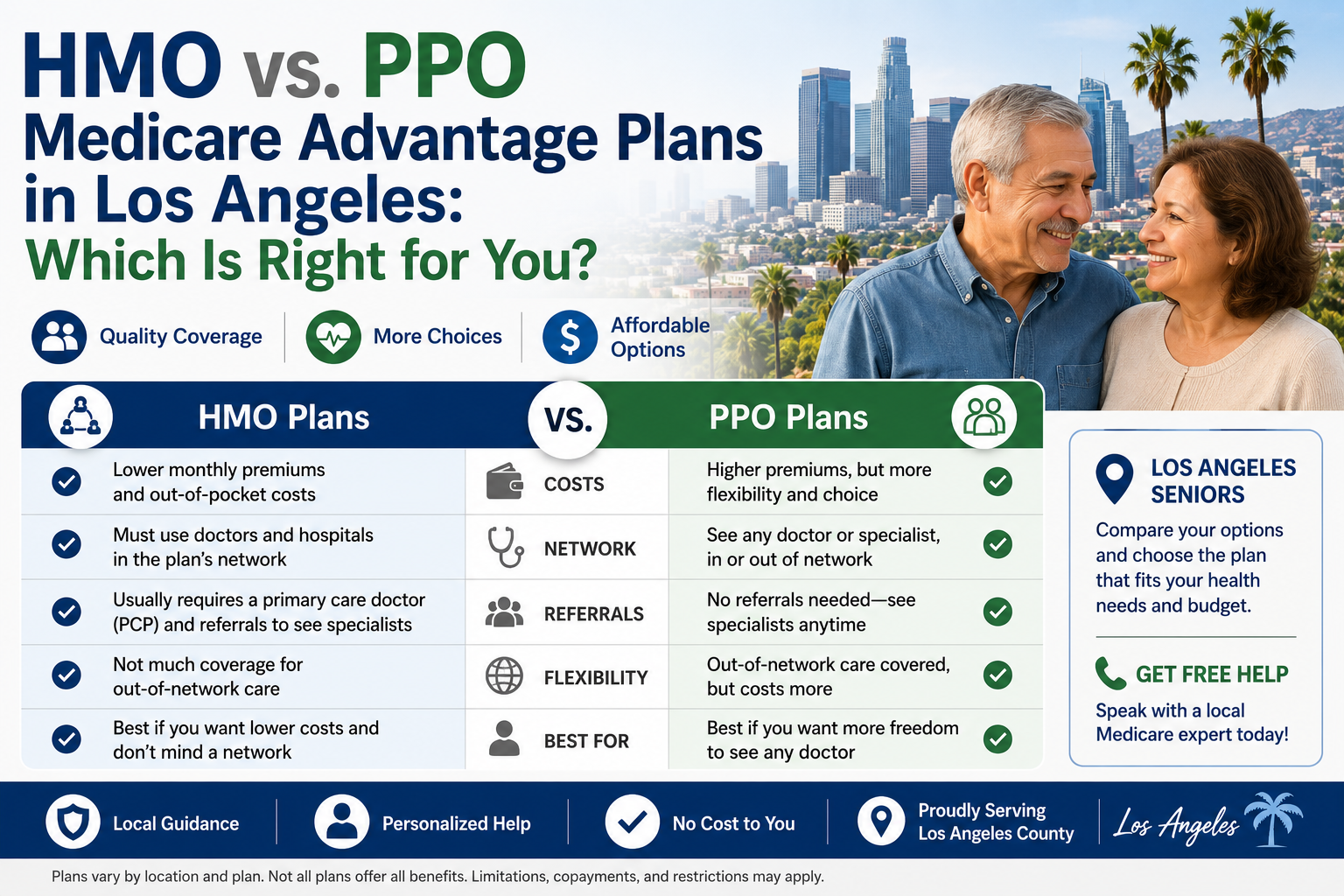
HMO plans generally:
• Require you to use doctors and hospitals within the plan’s provider network
• Generally require referrals for specialist visits
• Coordinate your care through a primary care physician
• Often have lower monthly premiums and structured copays
These plans may work well for people who receive most of their healthcare within one provider network.
PPO plans generally:
• Allow you to receive care from both in-network and out-of-network providers
• Do not require referrals
• Offer greater flexibility when choosing specialists
• Usually have higher costs when using out-of-network providers
Many Los Angeles Medicare beneficiaries compare PPO plans when they want more flexibility in choosing doctors and specialists.
D-SNP plans are designed for individuals who qualify for both Medicare and Medi-Cal.
Depending on the plan, benefits may include:
• Transportation assistance
• Dental benefits
• Vision coverage
• Prescription drug coverage
• Care coordination
• Over-the-counter allowances
Several D-SNP plans are available throughout Los Angeles County for qualifying beneficiaries.
A lower monthly premium may look attractive, but it is only one part of the overall cost picture.
Healthcare in Los Angeles is closely connected to major hospital systems and physician groups such as:
• UCLA Health
• Cedars-Sinai
• LA General Medical Center
Some Medicare Advantage plans have stronger relationships with certain medical groups than others.
If your doctors are concentrated within one healthcare system, an HMO may work well.
If you regularly receive care from specialists affiliated with multiple healthcare systems, a PPO may provide additional flexibility.
Many residents receive care through UCLA Health physicians and specialists.
• HMO: May work well if your providers are within one network.
• PPO: Helpful if you see specialists outside that network.
Many residents receive care through Cedars-Sinai physicians and affiliated medical groups.
• HMO plans may fit well when your providers are concentrated within one healthcare system.
• PPO plans may provide additional flexibility if you receive care from several physician groups.
Many beneficiaries receive care through LA General Medical Center and affiliated clinics.
• Reviewing provider participation before enrolling is especially important.
Many residents receive specialty care across multiple healthcare systems.
• PPO plans can be appealing when specialist access spans several provider networks.
Many Medicare beneficiaries receive care from physicians affiliated with different healthcare systems.
• Comparing provider directories before enrolling can help avoid unexpected network issues.
• Typically cover in-network services except for emergency or urgently needed care.
• You may need to change providers if your physician leaves the network.
• Cover both in-network and out-of-network care.
• Out-of-network care generally results in higher costs.
• Generally require referrals before seeing specialists.
• Do not require referrals to see specialists.
If you regularly see a cardiologist, orthopedic specialist, neurologist, oncologist, or another specialist, this difference can significantly affect your healthcare experience.
Before enrolling, verify access to:
• UCLA Health
• Cedars-Sinai
• LA General Medical Center
Hospital participation can vary depending on the Medicare Advantage plan, and individual physician groups may participate differently even within the same healthcare system.
Only if your Medicare Advantage plan includes that physician or medical group in its network. Not every plan contracts with every provider.
Yes. If your providers are spread across multiple healthcare systems, comparing PPO plans may be worthwhile because they offer additional provider flexibility.
• PPO plans: Yes, referrals are not required.
• HMO plans: Referrals are generally required.
Many seasonal travelers compare PPO Medicare Advantage plans and Medicare Supplement plans because they may provide broader provider access while traveling.
Possibly, but it depends on your Medicare Advantage plan’s provider network. Reviewing your doctors before enrolling is important.
Include:
• Primary care physician
• Specialists
• Preferred hospitals
Do not assume a doctor participates simply because they accept Medicare.
Especially if you regularly see:
• Cardiologists
• Orthopedic specialists
• Neurologists
• Cancer specialists
Review:
• Monthly premiums
• Specialist copays
• Hospital costs
• Maximum out-of-pocket limits
Ask yourself:
• Do I travel frequently?
• Do I prefer greater provider flexibility?
• Am I comfortable receiving care within one network?
• Do I regularly see specialists across multiple healthcare systems?
Choosing between an HMO and PPO Medicare Advantage plan in Los Angeles comes down to how you use healthcare.
Some Medicare beneficiaries prefer the coordinated care and lower monthly costs often associated with HMO plans. Others value the flexibility PPO plans provide.
From Westwood to Beverly Hills, Downtown Los Angeles to Sherman Oaks, Pasadena to Glendale, your Medicare experience depends heavily on how your plan aligns with your doctors, hospitals, prescriptions, and healthcare routine.
Working with someone who understands Medicare from a local Los Angeles perspective can help you compare plans, understand your options, and choose coverage that fits your healthcare needs.
As your Los Angeles Medicare insurance advocate, The Popel Insurance Group can help you:
• Review your doctor and prescription drug list
• Check provider access across UCLA Health, Cedars-Sinai, and LA General Medical Center
• Compare HMO, PPO, D-SNP, Medicare Advantage, Medicare Supplement, and Part D prescription drug options
• Help you enroll based on your healthcare needs and neighborhood
Call (888) 412 – 2399