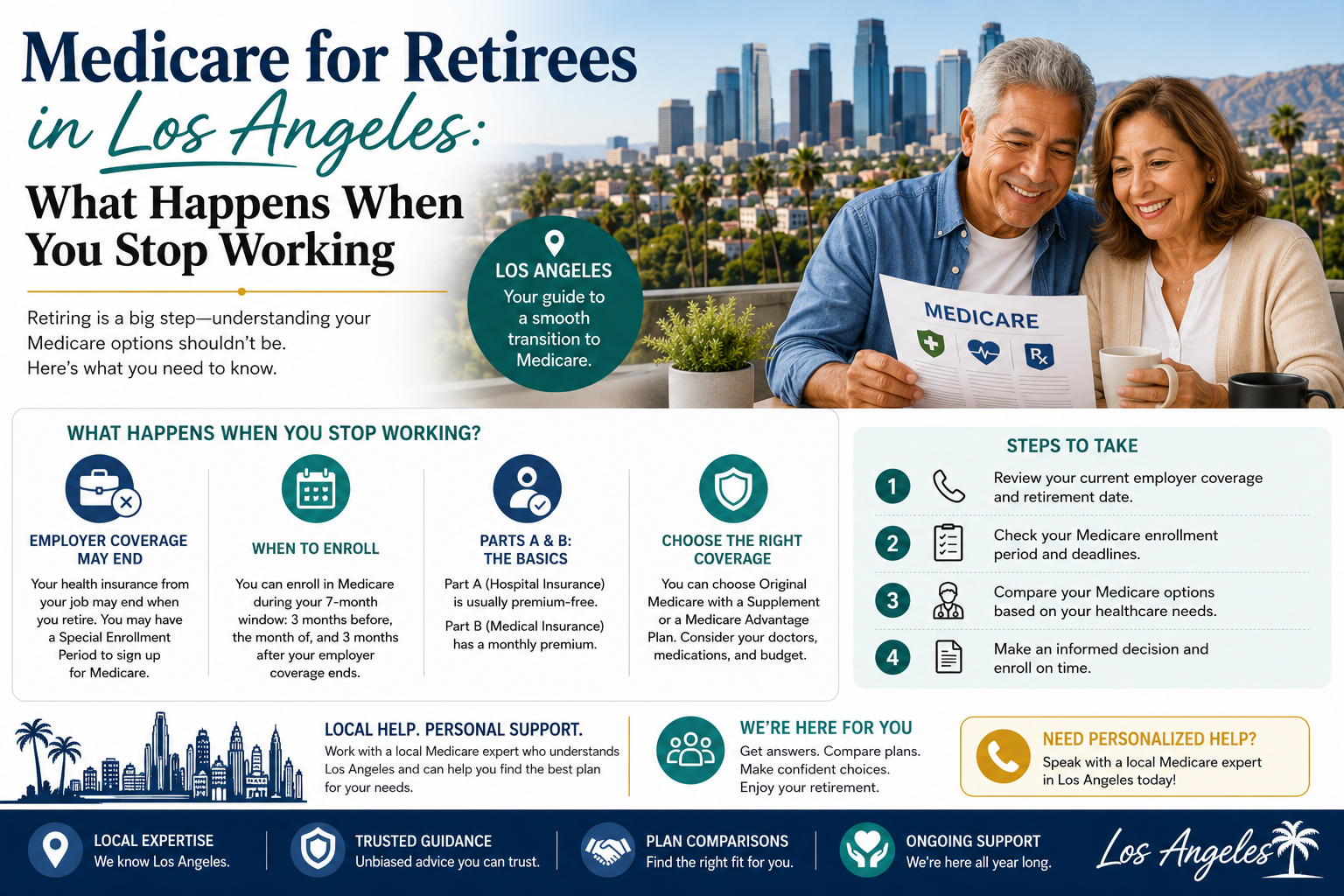
Medicare for Retirees in Los Angeles: What Happens When You Stop Working
Retiring in Los Angeles, California is a major milestone, but when you stop working, your health insurance situation can change quickly.
Employer coverage often ends, Medicare becomes part of the conversation, and suddenly you’re expected to understand enrollment timelines, provider networks, prescription drug coverage, and plan options that may not have been clearly explained.
Whether you’re retiring in Westwood, Beverly Hills, Brentwood, Santa Monica, West Hollywood, Downtown Los Angeles, Boyle Heights, Sherman Oaks, Encino, Woodland Hills, Pasadena, or Glendale, this guide explains what typically happens when you retire and how Medicare works from a local Los Angeles perspective.
Step One: Employer Insurance Ends — Medicare Begins
When you retire:
• Your employer health insurance usually ends.
• Medicare often becomes your primary health coverage.
• You may need to actively enroll in Medicare Part B.
• Your decisions can affect:
o Your doctors
o Your hospitals
o Your prescription drug coverage
o Your monthly healthcare costs
o Your access to specialists
This is more than paperwork—it becomes the foundation of your healthcare throughout retirement.
Medicare Options for Los Angeles Retirees
Original Medicare (Part A & Part B)
Original Medicare allows you to receive care from providers nationwide who accept Medicare.
However:
• Prescription drug coverage is not included.
• There is no annual cap on out-of-pocket medical costs.
• Dental, vision, and hearing services are generally not included.
Many retirees choose to add a Medicare Supplement (Medigap) plan along with a standalone Part D prescription drug plan.
Medicare Advantage Plans (Part C)
Medicare Advantage plans combine:
• Hospital coverage (Part A)
• Medical coverage (Part B)
• Often prescription drug coverage (Part D)
• Additional benefits that may include dental, vision, hearing, fitness programs, and more
Common Plan Types in Los Angeles
HMO (Health Maintenance Organization)
• Uses a provider network for most services
• Generally requires referrals for specialist visits
• Often has lower monthly premiums
• Frequently organized around local physician groups and healthcare systems
PPO (Preferred Provider Organization)
• Offers both in-network and out-of-network coverage
• Does not require referrals
• Provides greater flexibility when choosing specialists
• Out-of-network care generally costs more
D-SNP (Dual Eligible Special Needs Plans)
D-SNP plans are designed for people who qualify for both Medicare and Medi-Cal.
Depending on the plan, benefits may include:
• Transportation assistance
• Dental and vision coverage
• Prescription drug coverage
• Care coordination
• Over-the-counter allowances
Several D-SNP plans are available throughout Los Angeles County for qualifying beneficiaries.
Medicare Supplement (Medigap) + Part D
Another option combines:
• Original Medicare
• A Medicare Supplement plan
• A standalone Part D prescription drug plan
This option generally offers:
• No Medicare Advantage-style provider networks
• No referrals
• Nationwide access to providers who accept Medicare
• More predictable out-of-pocket medical costs
Why Hospital Networks Matter in Los Angeles
Choosing Medicare in Los Angeles often comes down to more than comparing plan names.
Many residents receive care through one or more of these healthcare systems:
• UCLA Health
• Cedars-Sinai
• LA General Medical Center
Not every Medicare Advantage plan includes every physician group or hospital system.
For example:
• Some HMO plans may work closely with one healthcare system.
• Some plans may include certain specialists but not others.
• PPO plans may offer additional flexibility if your providers are spread across multiple healthcare systems.
This is one reason local Medicare guidance can be valuable.
Neighborhood Reality in Los Angeles
Where you live often influences where you receive healthcare.
Westwood & Brentwood
Many residents receive care through physicians affiliated with UCLA Health.
Beverly Hills & West Hollywood
Many residents rely on Cedars-Sinai physicians and affiliated medical groups.
Downtown Los Angeles & Boyle Heights
Many beneficiaries receive care through LA General Medical Center and affiliated clinics.
Healthcare in Los Angeles is not built around one single network—it is a collection of hospitals, physician groups, and specialists.
Network & Doctor Access: What Retirees Should Check
Before choosing a Medicare plan, confirm:
• Is your primary care physician in-network?
• Are your specialists included?
• Does the plan work with your preferred hospital system?
• Does the plan require referrals?
• Is prescription drug coverage included?
• What are the out-of-network rules?
Quick Medicare Comparison
HMO Plans
• In-network care for most services
• Referrals generally required
• Often lower monthly cost structure
PPO Plans
• In-network and out-of-network access
• No referrals required
• Greater flexibility for specialist care
Medicare Supplement Plans
• No provider networks
• No referrals
• Nationwide access to providers who accept Medicare
Real FAQs from Los Angeles Retirees
"I'm retiring and my doctor is affiliated with UCLA Health. Can I keep them?"
Possibly, but it depends on whether your Medicare Advantage plan includes that physician or medical group in its network, or whether you choose Original Medicare with a Medicare Supplement plan.
"I live in Sherman Oaks and see specialists at both Cedars-Sinai and UCLA Health. What should I consider?"
If your providers are spread across multiple healthcare systems, comparing PPO Medicare Advantage plans and Medicare Supplement plans may be worthwhile.
"Do any Medicare plans help with transportation?"
Some D-SNP plans include transportation benefits for qualifying beneficiaries.
"Will I need referrals after I retire?"
• HMO plans generally require referrals.
• PPO plans do not require referrals.
• Medicare Supplement plans do not require referrals.
"I travel outside California during the year. Will my coverage travel with me?"
• HMO plans may have more limited coverage outside their service area except for emergency or urgently needed care.
• PPO plans generally provide additional flexibility.
• Medicare Supplement plans typically allow access to providers nationwide who accept Medicare.
What Los Angeles Retirees Should Do First
1. Make a list of your doctors.
2. Write down your preferred hospitals.
3. Review your prescription medications.
4. Determine whether you qualify for Medi-Cal if applicable.
5. Compare HMO, PPO, D-SNP, Medicare Advantage, and Medicare Supplement options.
6. Verify provider networks—not just plan names.
7. Choose coverage based on your healthcare needs, travel habits, and lifestyle.
Final Thought: Retirement Should Feel Like Freedom—Not Confusion
Retirement should give you more time to enjoy life—not more time worrying about health insurance.
The Medicare plan you choose should support:
• Your doctors
• Your hospitals
• Your prescriptions
• Your budget
• Your daily routine
From Westwood to Beverly Hills, Downtown Los Angeles to Sherman Oaks, Pasadena to Glendale, your Medicare experience depends on how well your coverage matches the way you receive healthcare.
Working with someone who understands Medicare from a local Los Angeles perspective can help make that transition easier.
Need Help Comparing Medicare Plans?
As your Los Angeles Medicare insurance advocate, The Popel Insurance Group can help you:
• Review your doctor and prescription drug list
• Check provider access across UCLA Health, Cedars-Sinai, and LA General Medical Center
• Compare HMO, PPO, D-SNP, Medicare Advantage, Medicare Supplement, and Part D prescription drug options
• Help you enroll based on your neighborhood and healthcare needs
Call (888) 412 – 2399